
DVLED vs LCD Displays for Modern Boardrooms
Assessing DVLED vs LCD displays for modern boardrooms
Choosing between DVLED and LCD panels is now a common decision to be made by IT managers, facilities teams and AV consultants specifying professional boardroom systems. The right choice affects user experience for Microsoft Teams Rooms and Zoom Rooms, integration complexity, maintenance and long-term total cost of ownership. This article compares practical operational and technical considerations to help you select the ideal display technology for your meeting spaces.
Visual performance and user experience
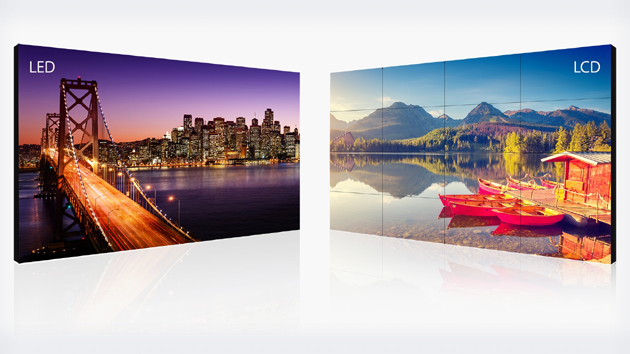
DVLED (direct-view LED) offers seamless, bezel-free canvases, high peak brightness and excellent contrast. And significantly, DVLED offers an extensive range of ultra-large physical wall sizes. Those characteristics make DVLED well suited for large-format, high-impact collaboration displays where multiple sources of content, detailed application data and video feeds must remain clear even under bright ambient lighting. Fine-pitch DVLED can deliver pixel density that supports close viewing typical in executive boardrooms.
LCD displays and LCD video walls remain a strong option for many meeting rooms. Commercial LCD panels give high native resolution, (typically 4K), accurate colour reproduction and wide viewing angles depending on panel technology (ADS, IPS, etc). LCDs are typically more familiar to internal IT and Facilities teams, integrate straightforwardly with standard signal extenders and are generally lower initial capital cost for small-to-medium sizes.
Integration with conferencing systems and AV control
Both DVLED and LCD integrate with Microsoft Teams Rooms and Zoom Rooms via their AV ecosystem: video codecs, presentation systems, room control and audio/peripheral management. Key integration considerations include:
- Signal processing: Most DVLED systems require video wall controllers or direct input scalers to manage multi-window layouts and resolutions. LCDs often accept native 4K inputs with simpler scaler requirements and capabilities.
- Control and automation: Ensure the chosen display supports standard control protocols (RS-232, IP, or vendor APIs) for seamless integration with room control systems and calendaring triggers.
- Both technologies will integrate well with control platforms such as Crestron, Q-SYS, AMX or Cyviz but the seamless image and custom canvas size available with DVLED offers additional capabilities and control considerations. The optimal system will leverage the horsepower of an integrated control platform to also process and control your collaboration software, peripheral devices, cameras and audio system.
Operational reliability and maintenance
Reliability and ease-of-service are critical for enterprise boardrooms. DVLED arrays are modular; individual LED cabinets can be swapped for maintenance, and many vendors support front access for on-wall installations. Consider a module sparing strategy and preventive calibration service to maintain uniformity over time. DVLED systems may require more stringent ventilation and power planning due to heat dissipation depending on the chosen technology. COB (and particularly FCOB) tends to run cooler than SMD versions of the panel technology.
LCD systems have well-understood maintenance paths: replacing individual panels, backlight units or power supplies is typically straightforward. However, multi-panel LCD video walls introduce bezels between panels and can show visible seams that may affect certain presentation types.
Cybersecurity, firmware and lifecycle management
Both display types increasingly include networked processors and web-based management interfaces. Treat display devices as networked endpoints: place them on segmented management VLANs, enforce strong firmware update policies and work with vendors who publish security advisories. Factor expected lifecycle, vendor support windows and warranty coverage into procurement decisions.
Cost, scalability and room-fit
DVLED typically carries higher upfront costs, especially for very fine pixel pitches, but can offer superior longevity and impact. LCD is cost-effective for smaller rooms or where budget constraints prioritize rapid deployment. When scaling across multiple rooms, align pixel pitch and panel size with required viewing distances and content types to optimize spend without compromising user experience.
Selecting the correct DVLED product based on the function of the room, physical conditions and spatial factors, type of content and overall use-case is different than LCD, and we will have a separate article on tackling these considerations. But in the end you will want to lean on your DVLED product expert and integration partner for the best advice in your particular application.
Conclusion
Deciding between DVLED vs LCD displays comes down to room size, viewing distance, ambient lighting, integration needs with Microsoft Teams Rooms or Zoom Rooms, content, and long-term maintenance strategy. DVLED excels for immersive, seam-free displays and high ambient-light tolerance; LCD provides proven reliability, lower initial cost and simpler signal workflows for many standard boardrooms.
CCOMM can help evaluate room requirements, specify the appropriate display technology, and integrate the display with conferencing systems, audio, camera and control infrastructure. We also provide lifecycle support plans that address firmware management, serviceability and operational continuity for all of your meeting rooms.